
Table of Contents
Most builders want their website to perform. The hard part is defining what that actually looks like for their business. For some, the priority may be becoming easier to find through online search. For many, it’s a website that generates leads.
We’ve worked with builders who genuinely can’t remember the last time an inquiry came through their website. Others are already generating leads, but they want better ones. They want clients with higher budgets, projects that align with the work they want to build, and homeowners who already understand and respect their process.
Those goals look different, which is exactly why website analytics for builders shouldn’t be reduced to one big traffic number. More website visitors might feel exciting, but traffic alone doesn’t tell you whether your website is actually doing its job. A strong website strategy starts by defining what success looks like for your business, tracking the right numbers that actually tell you something, and using that information to make better decisions over time.
Start With Traffic and Conversion Rate
If you’re starting from zero, you don’t need to track dozens of metrics. We’d start with two: unique monthly visitors and website leads. Unique visitors tell you how many individual people are finding your website each month. Website leads tell you how many of those visitors take the next step and submit your inquiry form.
From there, you can calculate your conversion rate by dividing the number of leads by your unique monthly visitors and multiplying by 100. If 1,000 people visit your website and ten submit an inquiry, your conversion rate is 1%.
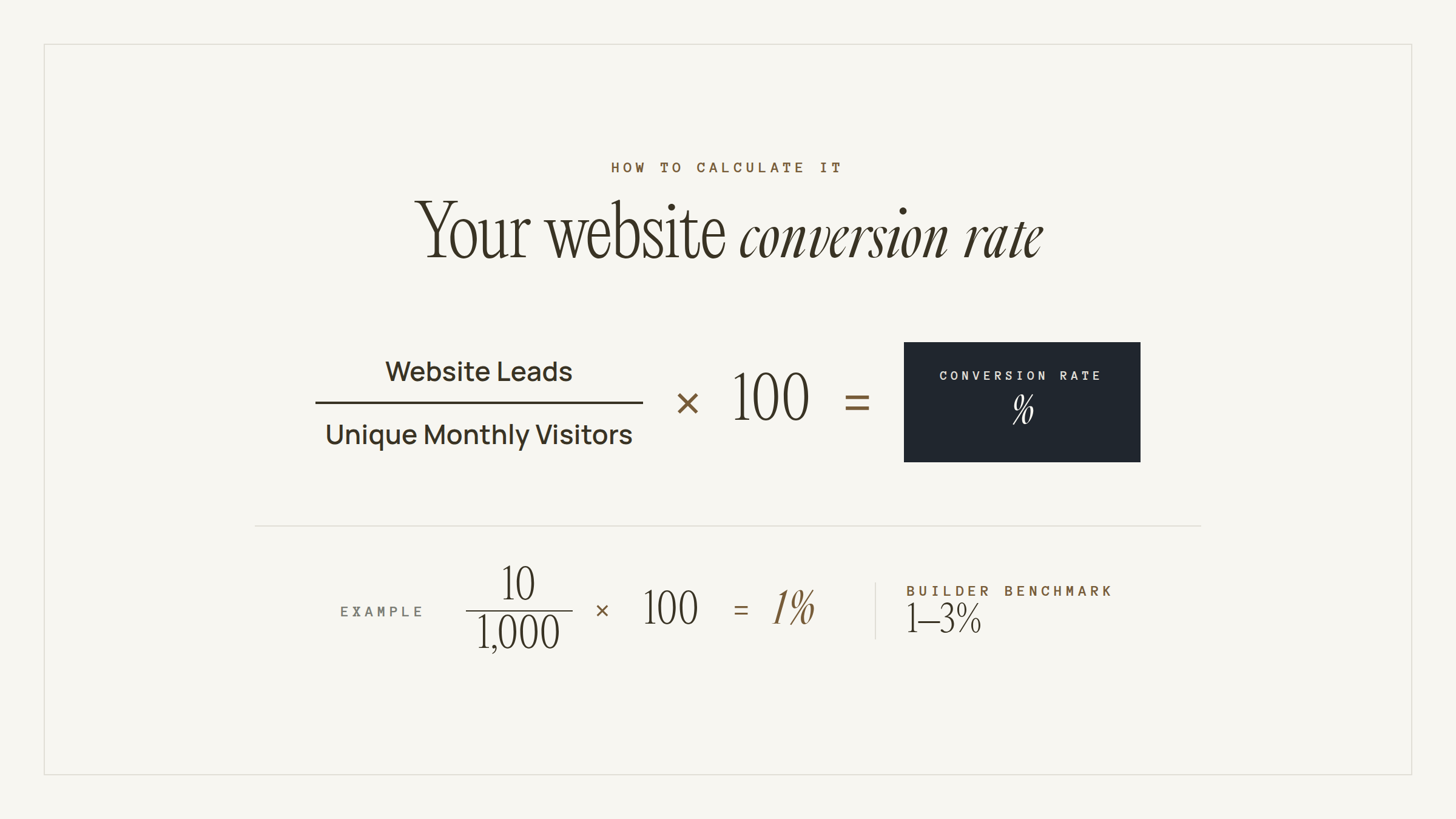
For custom home builders, we generally like to see a conversion rate around 1–3%. Even a little below that can be completely reasonable when we’re talking about a high-ticket service with a long decision-making process. You don’t need to chase some universal benchmark, but we do want to establish your baseline, understand what’s normal for your business, and look for improvement over time.
We also like to look beyond visitor-to-lead conversion and track what happens after the form comes in. Your lead-to-consultation rate tells you whether the website is doing a good job of filtering. A high number of inquiries means a lot less if most of those people aren’t qualified enough to make it to a consultation.
Pay Attention to Where Your Traffic Comes From
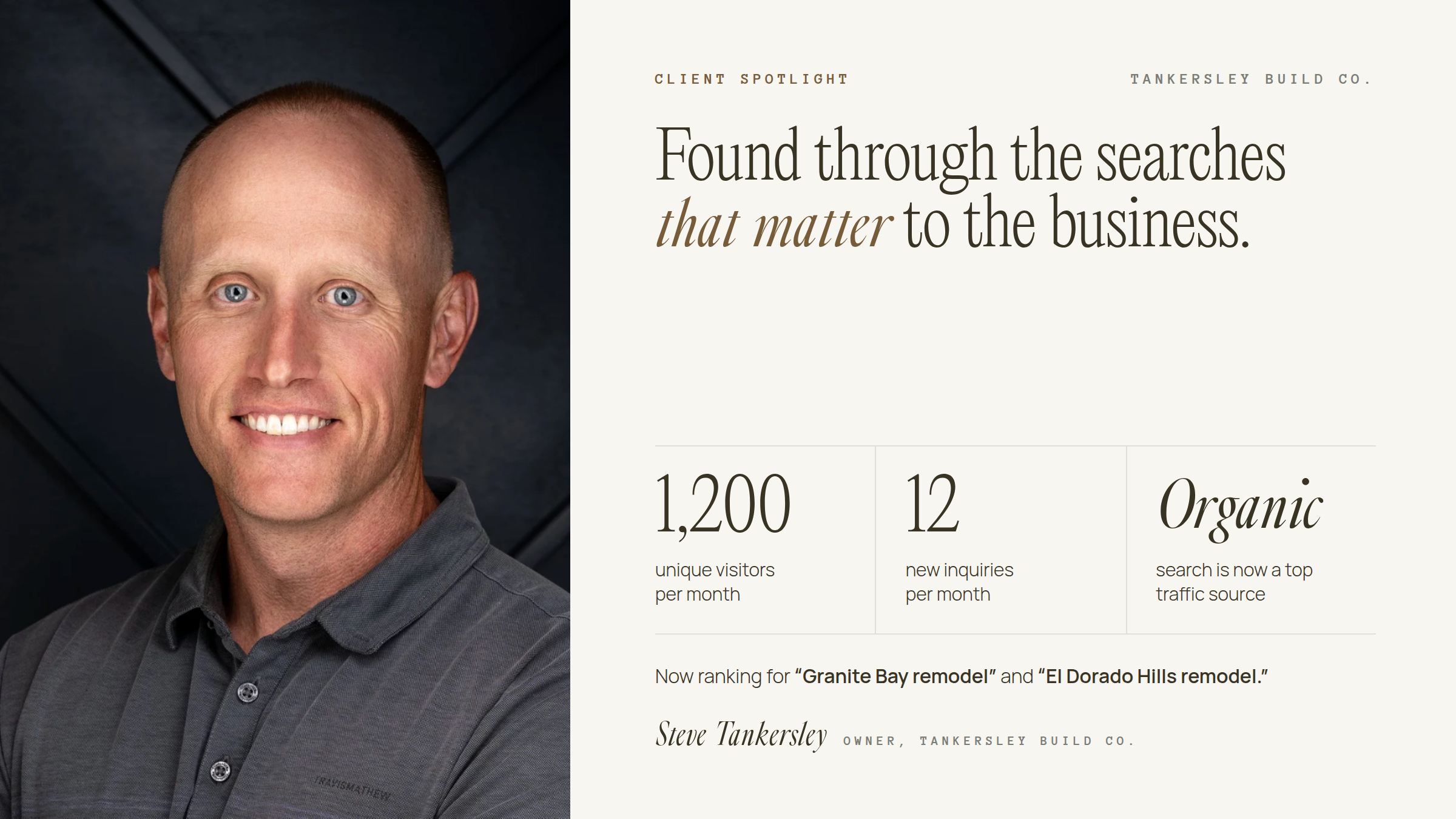
Once you know how many people are visiting and how many are converting, traffic sources give you important context around what’s driving those numbers. Organic traffic shows you how many visitors are finding you through search. Referral traffic can show the impact of builder partnerships, industry directories, publications, or other websites sending people your way. You can also see traffic coming directly to the site, from social media, or through paid advertising.
What that means for you is that “we got 40 leads” becomes a much more useful conversation. When you know where those visitors came from, you can start connecting your results back to the marketing investments you’re making.
That gives us much more information than just knowing their traffic increased. We can see that people are finding the website through the searches that matter to the business, and those visitors are turning into real inquiries.
If you need help getting better leads, try this blog!
Look at the Pages People Actually Enter Through
Not everyone starts on your homepage. Someone might find a project through Google, click a Pinterest image that takes them directly to a gallery, or land on your process page while researching what it’s like to build a custom home. Looking at your top landing pages shows you which pages are creating that first impression.
This is where analytics can start informing website strategy in a practical way. If a project gallery is consistently bringing new visitors to the site, that page needs to do more than display beautiful photography. It should give visitors enough context to understand your work and an obvious next step when they’re ready to learn more.
The same principle applies to your service, process, and location pages. When you know which pages people are finding first, you can make sure those pages are doing enough to build trust and guide someone deeper into the site.

Track What Happens on Your Inquiry Form
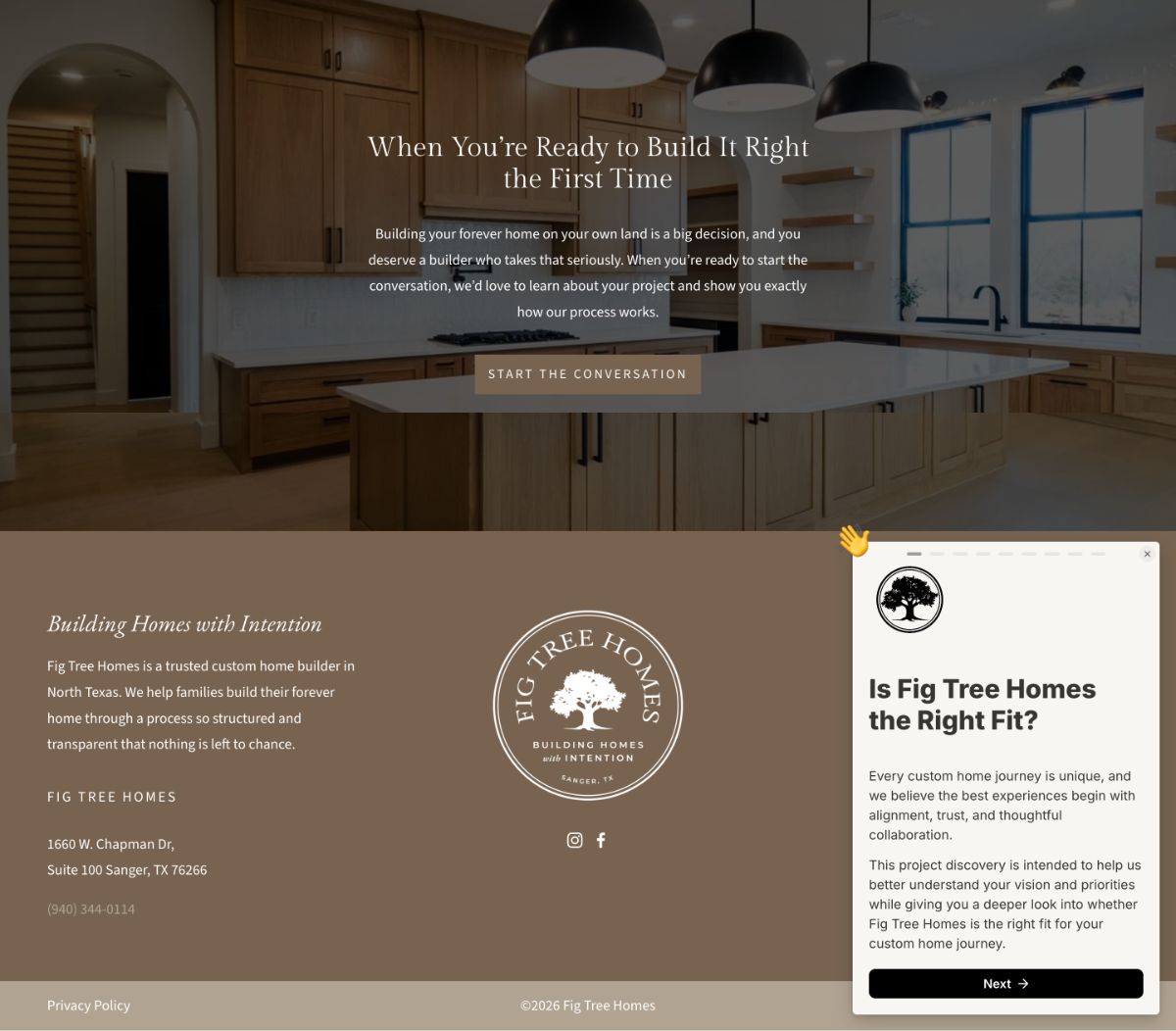
One metric we think more builders should pay attention to is the difference between form starts and form completions. If people are visiting your contact page and never touching the form, the issue may be somewhere earlier in the website experience. If they start filling out the form and consistently abandon it, you’ve learned something completely different.
The form itself may be too long, clunky on mobile, or asking for information in a way that makes people hesitate. That’s a website experience problem, not necessarily a traffic problem. This is why looking at the full journey matters. Conversion rate tells you that something is or isn’t happening. Looking at visitor behavior helps you understand where the disconnect might be.
Don't Get Distracted by Vanity Metrics
Builders can easily get pulled into numbers that look impressive without telling them much about whether the website is working. Total pageviews are a good example. 100 pageviews from people who immediately leave aren’t necessarily more valuable than ten pageviews from a prospective client who studies your portfolio, reads through your process, and comes back a week later to submit an inquiry.
Site-wide bounce rate can be misleading for the same reason. Someone could read an entire process page, get exactly the information they needed, and call the phone number they saved earlier. Analytics may not recognize that as a successful visit.
Time on site is more useful with context. As a general directional benchmark, we like seeing visitors spend more than three minutes on a builder’s website, but the pages they’re spending that time on matter. Three minutes exploring a project is very different from three minutes struggling with a contact form. At the end of the day, the numbers worth your attention are the ones that help you understand whether the right people are finding your website, engaging with it, and taking the next step.
Give Your Data Enough Time
One of the biggest analytics mistakes we see is changing too much too quickly. A builder launches a new website and immediately starts adjusting the homepage, form, hero image, copy, and gallery layout. If leads go up, there’s no way to know which change helped. If leads go down, there’s no clear place to start troubleshooting.
We often tell clients to give a new website at least 90 days before making changes based on performance data. Six months is even better. Custom home building has a long sales cycle, and lead flow can be seasonal. One slow month doesn’t mean your website has stopped working. You need a baseline before the numbers become useful. Once you have it, make intentional changes one at a time and give each one enough time to show you something.
Better Website Analytics Lead to Better Decisions
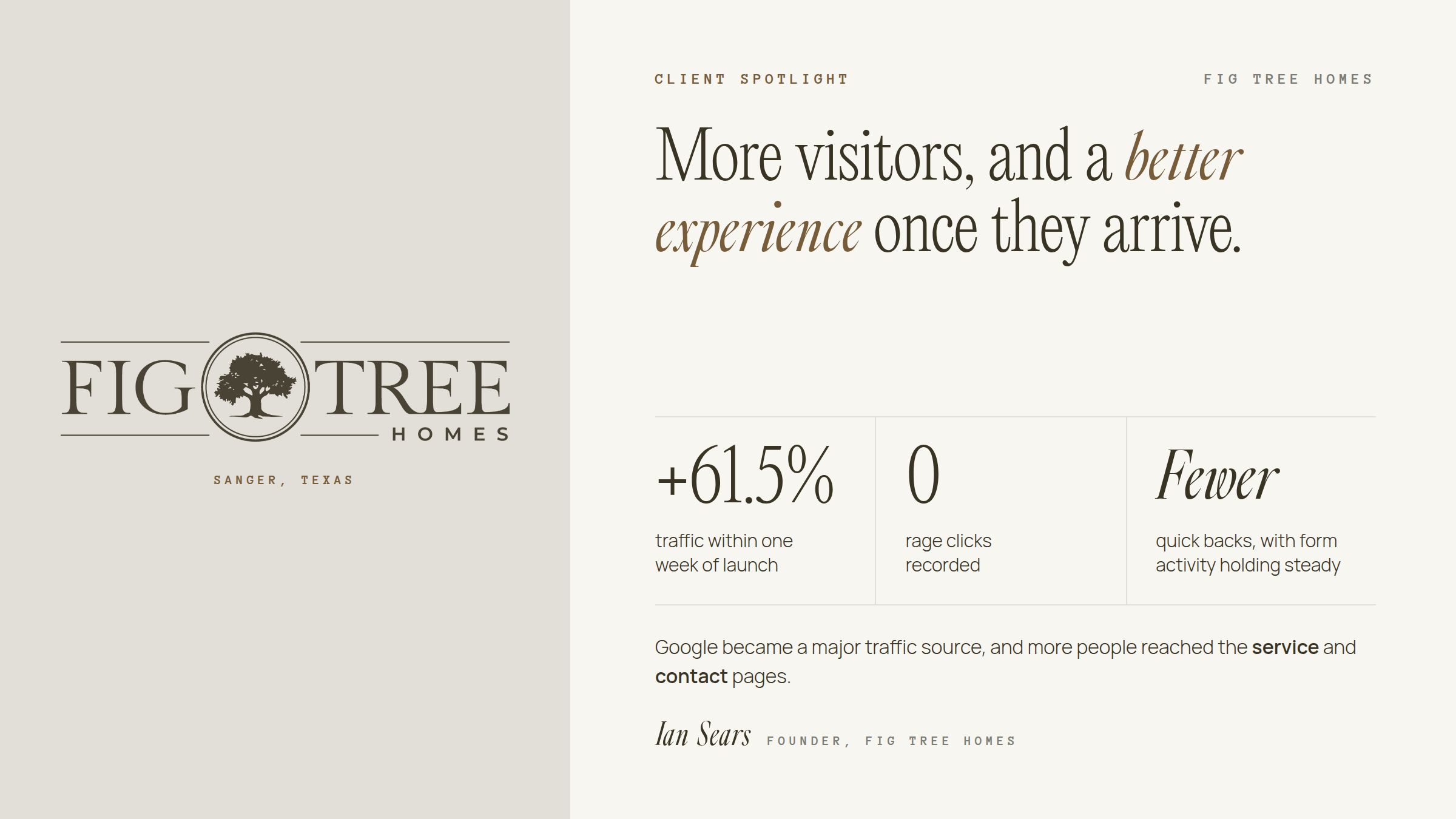
For Fig Tree Homes, we weren’t just seeing more visitors. We were seeing signs that people were having a better experience once they arrived. That’s what website analytics for builders should give you. You don’t need a dashboard filled with numbers you never look at. You need enough reliable information to understand what’s working, spot where people are getting stuck, and make strategic decisions based on actual behavior instead of assumptions.
Your website should give you measurable insight into how people find you, how they engage with your business, and whether the right ones are taking the next step. If it’s not, schedule a Discovery Call to build a website strategy that works for you.